Wednesday, May 18, 2016
51 Hours Old
8pm 13/4/16
Dear Airlie,
You're 51 hours old as I sit here cuddling you to my breast. Not feeding, just cuddling and just being.
I realised I hadn't yet told you I love you out loud and so I did that, and then I had a big ugly cry as I came to understand how this moment right now will never be long enough. And there will never be enough days in our lifetimes for us to just be together. It's all already going too fast.
If I'm lucky, if I'm really lucky, I will live to be an old, old lady and maybe one day, hopefully a long time from now, you will hold me or hold my hand as I take my last breaths on this earth. You, right now, this tiny precious thing, who I held as you took your first breaths just 51 hours ago, will hold me as I hold you now. And it still won't be long enough. We will not have had enough time.
Where have these first 51 hours gone? I have been too busy trying to do everything right. Trying to feed right and sleep right and learn you like a science. Too busy notifying everyone and checking in and photographing you. It has all disappeared and I forgot, until now, to just love you and to tell you I love you. I love you. I love you. I love you.
I could stare at you, like this, right now, forever.
Love your mum, Bessie
Wednesday, May 27, 2015
Happy Birthday Hank!
DEAR HANK,
It’s my birthday this week which means it must be one year since you came into our lives… I guess that means your birthday was about eight weeks ago. I’m sorry we missed it, but how ‘bout we celebrate together this week instead?
It’s been 12 months since we brought you home in a cardboard box, so little when we first met.


But just a few weeks later we knew something was up… You were already the same size as your fully-grown new brother, Flip! Soon you were three times his size with a bark ten times as deep.

I don’t think it was easy for you to find your place in the family when Flip and I were already best buddies. I admit, the whole reason I chose you was because I loved him so much I thought the only thing that could be better was if I had two of him. But you have grown up to be different from Flip in almost every way, and yet I love you just as much!
Flip was quite jealous when you first arrived. I felt guilty and worried that I had done the wrong thing, that you and Flip would never see eye-to-eye and that you would have been better off somewhere else. But now you adore each other and we would all be less without you.

You are such a wonderful brother and mate to Flip and you make ST and I laugh endlessly. You are very clever – and naughty - the way you’ve taught yourself to jump over the fence to catch rabbits and scavenge for old roo bones. I’m not overjoyed about the amount of them that constantly scatter our lawn, but they make you and Flip happy and that’s the main thing. You don’t even mind sharing your catch with Flip, in fact a lot of the time I think he is the bossy little Lord Farquaad and you his faithful servant.

It’s funny how your mini-big dog stature has turned into a mini-big dog personality. Like life is all too hard when you’re a ‘big dog’ and you just need to have a nap. Right now. And all of the time.

It’s also pretty funny how absolutely terrified you are of the real ‘big dogs’.
You love to cuddle and snuggle. You love playing keepings-off Flip. And you love TV (not that you’re supposed to be inside)! You hate the rain, and thunder, and gunshots.
Remember that time you and Flip cornered that King Brown snake climbing the fence in the middle of the night? I threw you both in the house while ST and I “handled the situation” and later we couldn’t find you anywhere! We searched and scoured and called your name in every room of the house for 20 minutes before bringing Flip back inside to sniff you out. And there you were, curled up and frightened, between the bookshelf and the bed in the guest room. My poor baby.
And that other time when there was a Brown snake out the front and YOU ATE THROUGH THE CORD TO MY ENGLE FRIDGE (!!!) on the front veranda when I just trying to keep you safe! OK, let’s not remember that time, otherwise I’ll start on about the times you've done naughty things and tried to blame them on Flip!


And how you’ve recently started to pull clothes off the line and drag them around the yard (what is with that!?) and how you’ve kept me up two nights this week barking at… seriously, what ARE you barking at? I can’t see anything. Flip can’t see anything. There’s nothing there!
I swear to God, every time I see your head hit your paws today I’m going to shout your name. No naps for you!
You are lucky you’re cute, you big softy.

Happy Birthday Hank!
Love, Your Human xx
Friday, May 22, 2015
Stuffed Lamb Rib Flaps– The most delicious reason to have lamb for dinner this weekend
A FEW WEEKS back I had some requests for the Stuffed Lamb Rib Flaps recipe, so here it is!
I can’t take any credit for the idea. As far as I know people have been stuffing lamb flaps since the invention of lamb and stuffing, but I first discovered it when I moved to Burragan and was suddenly given all the cuts of an entire lamb to cook with. ST said, “Why don’t you stuff them like my mum does?” Now, I’m not stupid, and only a stupid person would try to replicate a dish perfected by their mother-in-law, but after a while I was sick of cutting them up into individual ribs and marinating them, so I decided to give stuffing them a go. And I am sure I never knew food-love before I knew Stuffed Lamb Rib Flaps.
One of the best parts of growing sheep and cattle is that we get to eat our own meat. ST’s Dad is an excellent butcher and he and ST use a bandsaw to cut up the sheep carcass (after it has hung in the cool room for a few days) into all the different cuts of meat you’d usually see in a butcher shop, and then some.
While lamb leg roasts, shoulders, chops and shanks are all cuts you see often, I don’t recall ever having lamb flaps before Burragan. They are the breast section of the sheep that is left over after you cut off the loin and the rack and… well, basically all the other cuts!
Lamb Rib Flap laying Rib Side Up
Sometimes you see it boned out and rolled up into a roast. Sometimes you see it sliced up into individual ribs (the kind you put sticky sauce on and cook on the BBQ). Stuffing them with the bones still in requires less butchering and if you’ve got nice meaty ribs it really is the stuff food heaven is made from.
To prepare your flaps:
The tips of the rib bones must be sliced a little way down with the bandsaw first to make them easier to cut with a kitchen knife. I’m sure you could ask your butcher to do this when you buy your flaps, otherwise if you have a meat cleaver and strong arm muscles I’m sure you could do it yourself.
Lamb Rib Flap laying Rib Side Down
Prepare your flaps by slicing off any really thick sections of fat from the top, careful not to cut into the very thin layers of meat.
Create a pocket between the ribs and the meat by using a sharp knife to make small cuts along the edge of the flaps, using your hands to slowly peel back the top layers of meat as you use the knife to go deeper into the pocket.
You can use your fingers to push the meat layers away from the ribs by running them back and forth inside the pocket. You don’t have to be gentle, it doesn’t matter how pretty it looks on the inside, but you do need to be careful to not cut through the back or the top of the pocket – you only want one opening and that’s at the front.
To make your stuffing:
If you’ve got a favourite stuffing recipe then feel free to go with that or do your own thing. I like to use whatever I have on hand and that can change depending on how recently I’ve been to the supermarket, but generally my stuffing recipe is like this:
Finely diced leek or onion, lots of crushed garlic, pine nuts or roughly chopped walnuts, sliced sundried tomatoes and a generous amount of chopped fresh herbs such as rosemary, parsley, basil, chives, oregano etc. Use dried if you don’t have fresh. Add chilli if you like a bit of spice.
Fry it all up in a dash of oil or butter. If you’ve got some spinach or silver beat (or anything else green and leafy, aside from lettuce), finely slice a big handful and add that too. Add breadcrumbs (fresh bread ripped up or packet breadcrumbs), salt and pepper.
Turn the heat off and let it all cool for a bit before adding a couple of eggs. Mix it all together quickly to stop the egg from cooking on the warm frying pan base. If your mixture is too crumbly just add more egg, if it’s too runny add more breadcrumbs.
To stuff your flaps:
Make sure your stuffing is cool enough to handle with bare hands. Open up your flap pocket and stuff it, packing the stuffing together tightly.
Once you’ve stuffed your flaps as full as you can (wow, this is turning into a very saucy recipe!) while still able to close the top of the pocket, you need a really big skewer to weave through the top and bottom layers of the flap opening, to hold it closed. Knit the skewer between the rib bones, every third or fourth one along, and back through the top of the pocket etc. Depending on the size of the flap I can only ever get it to weave through about three times. This is fine.
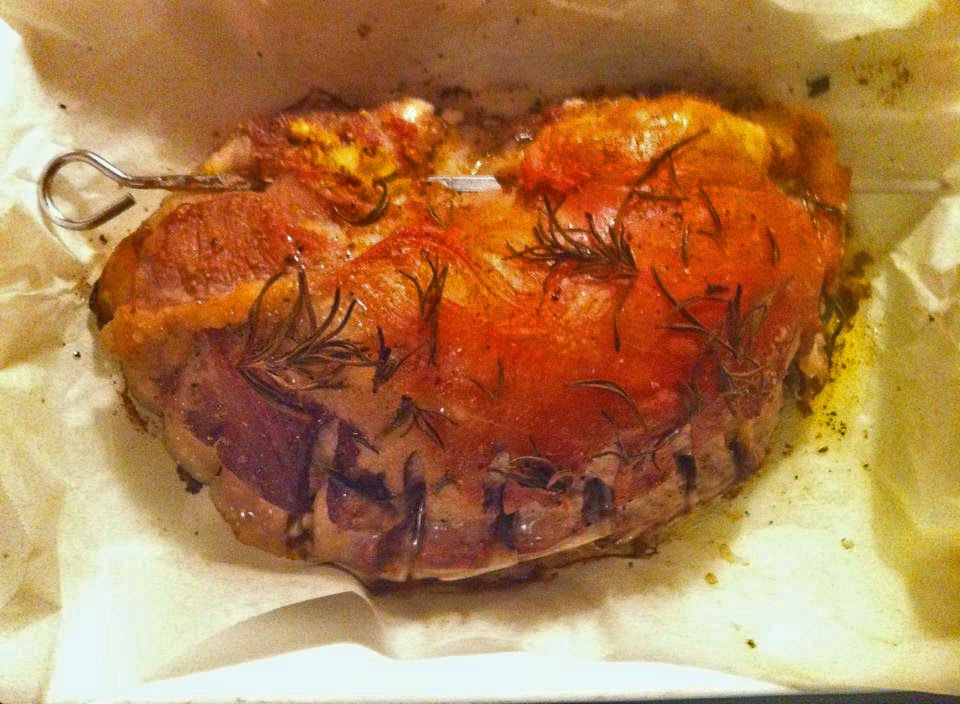
Cooked version pictured, sorry, I forgot to take a photo before I cooked it!
Finishing touches:
Dress the outside of your flaps as you would a lamb roast. I like fresh rosemary and salt and pepper but other herbs, spices, lemon, and garlic also go well. You can toss any roast veggies such as potato, pumpkin, sweet potato, zucchini, eggplant etc. around the flaps before you chuck them in the oven, or prepare something else on the side like harissa spiced sweet potato wedges.
Cook the flaps for about an hour on a moderate heat. I don’t think you can really over cook them, as long as they’re not burnt!
When they’re out of the oven use a large, sharp knife to slice between each rib, carving off individual stuffed ribs. Serve with your roast veggies and some steamed greens. Or save them 'til the next day and eat cold!
Enjoy!
Thursday, April 23, 2015
Is "local" food always best?
I LOVE THE idea of eating "local" but if I’m completely honest, sometimes it worries me. How near/far is local? If local is a couple of hundred kilometres then no one except ST and I would be eating Burragan lamb, mutton or beef. Which is what worries me.
I know it's only a smallish section of the population who can really afford to seek out meat direct from the farmer, but it’s important to note that it’s also only a smallish section of the farming population that can by-pass the middle man and sell direct to the public.
Australia is a huge country and around 60 percent of Aussie land is used for agriculture, according to stats from the World Bank. Between 6 and 7 percent of that is arable land used for growing crops, fruits and vegetables, meaning roughly 53 percent of that area is home to grazing animals – Burragan is in that 53 percent.
As you can imagine, a lot of agricultural land is covering areas of Australia that are a long, long way from the towns and cities, which, by the way, account for about 1 percent of Aussie land use.
Meanwhile – 64 percent of Aussie people live in capital cities. And only around 2 percent of us live in “rural” areas – that’s me!
There is a huge overlap there, between the majority of that 53 percent of land that’s growing animals and the 2 percent of people that live there.
I’m not saying it’s impossible for farmers within that 2 percent to sell direct to the public, but it is unreasonable to think all of them can or should. And just because they don’t, doesn’t make them any less fantastic farmers than the ones that are launching boutique brands and accessing new markets.
Burragan sheep and cattle are just as well cared for. ST and I are just as conscious about our environment, our practices, the welfare of our animals and the quality of the end product. And I know the vast majority of farmers looking after the land and animals within that 53 percent of Australia are the same.
But our meat ends up on a shelf at the supermarket or butcher shop alongside meat from thousands of other farms, indistinguishable from the rest.
Of course farmers seeking out direct to public avenues are doing a wonderful job and I hope their businesses are reaping the rewards of their hard work. Maybe we will head in that direction one day… who knows?
I know if we didn’t supply our own meat I’d love to be able to buy it through those types of avenues – I love knowing the story behind food and feeling that connection with a meal... and fortunately we get that for free at Burragan.
But not everyone sells local, and that doesn’t make our farming practices any less ethical, sustainable or innovative than the rest. We’re still supplying healthy, safe, affordable food, just to a different market. A market further afield.
If you can’t buy “local” don’t sweat it, because as long as it’s Aussie you’re probably buying from somewhere just like Burragan. And that’s just as good.
Do you try to eat local or Aussie food? How far do you think is still considered local?
Thursday, April 9, 2015
Best and Worst
THIS AFTERNOON a friend on Facebook posted a question: “What’s the best and worst thing about where you live?”
My answer came easy.
I had just tripped over an old loose section of tiles in my kitchen doorway, stubbing the two little toes on my left foot. ST is out doing a water run. After rolling around on the floor in agony for 10 minutes I managed to crawl to the freezer to extract some ice packs and then prop myself up in front of the laptop.
The worst thing about living where I live? Is being so far from medical help. Not that a doctor could do anything for my toes, whether they are broken or not, but those times when you do need a doctor, those times are excruciating.
The 110km emergency drive to a hospital that doesn’t even have a doctor, when someone you love is in pain, or sick, or scared… That is the worst.
But my best was an easy answer too.
And I think the best thing about living where I live beats the worst thing, even at the worst of times. Because the worst of times can happen anywhere… and they’re traumatic even if you only live minutes from the doctor. The best thing is a little more special, more privileged, more magical. And you get it every day!
The best thing is space.
Space to have pets and a garden (water permitting). Space to accommodate all your friends and family at once, even if they have to BYO swag. Space to not wake up the neighbours.
Space to buy really, really big toys and not worry about where you’re going to fit them.
Space to be your own person. Space to choose to be free of influence (if you want to be) from society.
Space to spread out and to get lost.
Space to find freedom.
Space to move around - if you’re not stuck on the floor with ice packed around your (possibly broken) toes.
Space to sit still.
Space to breathe.
Space to just be.
Combined, the three stations we run are a total area of around 800 square kilometres - which is totally and completely average for this region and absolutely teeny-tiny compared to regions further west and further inland.
But in that same space in Sydney, fit the lives of around 3 million people. And where I live, there are just four people...
Right now I kind of wish a certain one would come home and help me to the couch.
What's the best and worst thing about where you live?
Tuesday, September 9, 2014
Cock your hat - angles are attitudes
I was in Sydney two weeks ago for the Art4Agriculture Young Farming Champions #YFC14 Master Class, taking workshops on media interaction, public speaking, social licensing, and developing value statements and key messages – all in relation to food and fibre production. It was an exceptionally engaging weekend, with so many points sticking in my mind…
“There’s no good/bad/better/worse in food production systems, just different.”
“Trust is driven by confidence, competence and influential others.”
“Confidence comes from value similarity.”
“Consumer trust is driven by shared values rather than skills.”
“Sustainable balance = ethically grounded, scientifically verified and economically viable.”
And…
“Don’t just turn up to the ‘events’ – keep talking in between.”
I especially need to remember that last one. Life gets in the way oftentimes, but it’s important we keep the conversation going.
But there’s one thing that’s really been at the top of my mind since #YFC14 and it came from Canadian Nuffield Scholar Clayton Robins.
Clayton spoke to us about youth development organisation 4-H. It’s awesome. If you haven’t heard of it, you need to. Check out the website for Clayton’s local branch here: http://www.4h.mb.ca/
I’m not being intentionally dismissive of the fabulousness that is 4-H, but I want to move on quickly because that is not what’s been on my mind.
Clayton’s a fourth generation farmer from a mixed beef and cropping enterprise in south-west Manitoba. And according to him, his family farm is a “farm” – rather than a ranch - because he’s a “ball cap guy.”
It’s stereotypical of course, that a farmer wears a baseball cap and a rancher wears a wide-brimmed cowboy hat. (In Australian terms, we’re talking graziers on stations wearing Akubras.) But stereotypes can be useful sometimes, whether they’re right or wrong.
I love hats. And I reckon most farmers do. The right hat on the right person seems to become an extension of personality or an extra limb.
I have mentioned the many metaphorical hats a farmer wears previously. But now I’m talking literal, physical hats.
We have quite the collection of them. It includes lots of baseball caps. Mostly because suppliers and product reps like to give them as gifts. Buy a truck load of poly tanks? Here, have a free cap! Buy a pallet of chemical? Here, have a cap! Buy a grader? Here’s your matching cap!
The most recent addition was these awesome #australianagriculture and Art4Agriculture caps from the YFC workshop in Sydney.
When I presented ST with his, back home, he delightedly announced that this cap would be going straight into the ute to be worn when mustering on the motorbike. This was a good response, because many caps don’t ever make it off the hat rack – forever on the sidelines, never to fulfil their life’s purpose.
We have baseball caps for all occasions. And the funny thing is, that we actually do wear different caps for different occasions. ST has caps that are for mustering, caps that are for social occasions, caps for travelling, flash caps for Town trips, around the house caps, caps for particularly dirty jobs, and of course there are favourite caps, second favourite caps, least favourite caps… and so it goes on…
But generally, every day, we both wear wide-brimmed hats. ST’s is a traditional rabbit skin Akubra, while mine is straw.
It’s not unusual to have both ordinary day-to-day wear wide-brims and “stepping out” wide-brims. To wear while working, and to wear when attending farm themed events or visiting other farm properties, respectively.
It’s important to pick and choose the right hat for the right occasion because if you wear your good hat to the wrong event, your neighbours may never let you live it down. In some settings, too clean a hat can be equated (jokingly) to a lazy worker. The same can be said for boots. It’s all very political, this farmer fashion business.
But let’s get back on track…
If we are mostly wide-brimmed hat wearers, then by Clayton’s definition that means our farm is definitely a station.
We already knew this of course - we call it Burragan Station - but I like having a new data point to draw from.
The thing is… I don’t mind calling it a farm when the circumstances require it. For example, when I visited Hamilton North Public School in Newcastle two months ago. Or on this blog.
I also have no problem with calling myself a farmer (or farmer’s wife), rather than a grazier. I know it may seem like I use the term farmer with total reckless abandon. But it’s a conscious decision. Not the result of being new to station life, or taking advantage of artistic licence and gross commercialisation, as has been suggested to me in the past.
My reason is four-fold.
1) Grazier, to me, is a subcategory of farmer. Farmer is the overarching term which covers all food and fibre production. It’s a bit like someone introducing themselves as a doctor rather than a dermatologist. So I believe farmer is correct - just not as specific.
2) I see the word grazier as being more jargon than is necessary for many of my readers. I have lots of friends who read the blog who have spent most of their lives in Brisbane, Sydney and Melbourne. Saying grazier to them rather than farmer would be like a journalist using words like presser, grab or par (press release, quote and sentence) when talking to someone with no media experience. It’s about being less exclusive. Meanwhile, the graziers still know what I'm talking about anyway, so it's no harm to them.
3) To those not in the know, I believe the term grazier can conjure an overly-simplistic idea of livestock grazing on land, while the graziers just sit back and watch. Graziers are every bit a farmer as a farmer who tills the land. We are growing something (wool and lamb) every bit as alive and in need of "farming" as a cropping farmer. We prepare our paddocks and our mobs, we join the ewes and rams at certain times, we monitor the mobs as lambs are born and wool is grown - making sure there are no pests or diseases - we have periods of busy times when lamb marking and crutching, and then our "harvest" of shearing... All of this is the action of "farming.”
4) Last year I asked ST if it bothered him when people called him a farmer rather than a grazier. The conversation went a little something like this…
Bess: "Babe, do you mind when people call you a farmer rather than a grazier?"
ST: "No, why would I?"
Bess: "Well I've noticed a lot of graziers don't like being called farmers, because they say farmers are people who grow crops or plant pastures."
ST: "Well yeah, technically that's what we call a farmer I guess. But we're all farmers, it's just that specifically we have grazing country. I guess it depends what kind of country you have as to what specific type of farmer you are. But in the end aren't we all doing the same thing?"
So if the man calls himself a farmer, then that makes me a farmer's wife!
Meantime, we’ll still be wearing our wide-brimmed hats out in the paddock and our “ball caps” on other occasions. This is Australia after all; sun protection is vital.
"Cock your hat - angles are attitudes." - Frank Sinatra
Sunday, August 3, 2014
They are the Champions - My Young Farming Champion school visit at Hamilton North
I had one of the most fantastic experiences of my life last week. Have you ever walked into a strange place, a place you’ve never been before, full of people you’ve never met, and yet everyone knows your name and is excited to see you?
Last week that happened to me, as soon as I stepped through the school yard gate on my visit to Hamilton North Public School (HNPS), in Newcastle, as their Australian Wool Innovation (AWI) Wool Young Farming Champion for the Archibull Prize.
It was surreal at first. Confronting. And then thrilling. And has had me on a high for all the days since.
As HNPS Archibull coordinator and teacher Mrs Trudy Ramsay explained to the students, I spend most of my year on a relatively remote sheep station and can go for months where the only three other people I see are my husband ST and his mum and dad. To suddenly walk among swarms of children yelling out, “It’s Bessie! She’s here! Bessie’s here! Did you see? Bessie is here!” is… crazy… unreal… exhilarating… and incredibly hard to explain.
A group of students walked me to the office and others came rushing over to introduce themselves and high-five me, hug me and tell me how excited they were to finally have me here. Me? Me! Their Young Farming Champion.
In the background, other students walked by singing ‘She is a champion’ to the tune of ‘We are the champions.” I feel like you probably think I’m making this up. I’m not. It was totally crazy ridiculous. One hundred and eighty primary school students, from the centre of Newcastle, were buzzing with the thrill of having a sheep farmer from Wilcannia visit their school, and the first morning bell hadn’t even rung yet!
The grins on their faces were intoxicating and this glee set the tone for my two amazing days at Hamilton North.
The Art4Agcirulture Young Farming Champion program involves several training and development workshops before we’re allowed to step foot into schools. Through these workshops I’d created a presentation on my life, Burragan, and the wool industry, and my first morning at HNPS was spent touring the classes - first grades 5 and 6, then 3 and 4, and then K, 1 and 2 – and sharing my presentation with the students. This was well received and I ran out of time with each class to answer all their questions. They were enthralled and exceptionally interested in my stories of farming, sheep, and everything to do with how wool makes it from farm to fashion and beyond.
The students had so many questions! They wanted to know everything…
Where do the sheep sleep? Do you have to wash them? What kind of position are they in when they’re sleeping? What kind of things are there that can hurt them? Do you have to protect them? Would a ram scare away something that was going to hurt them? How much grass do they eat each day? How much water do they drink each day? Do any of them ever die? Do you have to give them medicine? Do you live near a vet? How do you get water out there? Do they like being shorn? Do you name them? What other animals do you have? Have you ever fallen off your motorbike? How long have you been riding a motorbike for?
Where did your very first sheep come from? Do you ever have to sell any sheep? Can you buy sheep and how do you do that? How do you get them into the shearing shed? How long does it take to shear a sheep? How exactly do you shear a sheep? Does it hurt them? Have you ever shorn a sheep? What’s your favourite animal on the farm? Do the sheep live in families? How many sheep did you say you have again? Wow!
Some questions were easier to answer than others.
The HNPS teachers were equally warm and welcoming, also asking lots of questions, praising my presentation, and hosting a special (and totally delicious) lunch for me in the staff room.
I then accompanied Mrs Ramsay to the school Environment Club meeting. I was exceptionally impressed that the students at HNPS were so environmentally aware. They have “Bin Free Tuesday” where everyone is encouraged to bring food that isn’t pre-packaged, so the bins shouldn’t need to be used on a Tuesday. There are rubbish monitors, bin monitors, worm farm monitors, compost heap monitors, and even chook monitors! Each of these people has to report in at the meeting to discuss the progress of their area or raise any issues. They graph all their results and brainstorm ways to improve things… including the energy usage of the whole school!
HNPS is on a tiny parcel of land, with a very small student catchment area, and it is only a few kilometres from the city centre. Principal Kelly Deakin took me on a school tour. Within this urbanised environment the students and teachers have created a gorgeous oasis, with a real focus on sustainability and community.
As well as a tadpole pond and some gorgeous laying hens who free range through the school grounds (and sometimes into the classes!) after lunch time, the students also grow fruit and vegetables. These are often sold to the local community on market garden days, though sometimes they have cook up days at school too. HNPS is particularly proud of its raspberry patch, its homemade lemonade and is worm-water liquid fertiliser. The latter obviously not used as food so much as for growing food.
After lunch and a tour, I joined the all school assembly where students took the opportunity to ask me more questions that they’d thought of after my classroom presentations. Again, we ran out of time! They wanted to discuss every little detail of farm life and growing wool… such a huge topic to fit into just a few days!
For the rest of the afternoon and the next day I spent time with Mrs Ramsay and five fabulous grade four students who make up the HNPS Archibull Blog Editorial Team: Mable, Hayley, Ava, Bella and Ava. The girls picked my brain for industry knowledge, taking down notes for their compulsory blog topics and discussing more in-depth topics such as different breeds of sheep, a year in the life of a sheep at Burragan and the various properties of wool. Given their interest in the environment, the Editorial Team was particularly delighted to hear that wool is biodegradable.
These girls blew my mind! They were so enthusiastic, attentive and eager to learn. Their grasp of all the concepts we discussed was incredible, as were their technology skills! They each had laptops, typed up their notes, emailed them to Mrs Ramsay and then updated their Archibull Blog right in front of me. It wasn’t that long ago that I finished school, and given that I’m not around children often probably shelters me, but to see these nine and ten year olds use this technology so innately stunned me. Anyone my age who’s had to talk their mother/father through sending an email, over the phone, will understand!
Unfortunately the students actually had to do real school as well, and learn about things other than wool, so my time was up. The school captain and vice-captain presented me with a box of handmade (by one of the student’s dad’s, who owns a restaurant) chocolate truffles before leading their Archibull statue through a line-up of all the students clapping, and I was instructed to follow the parade as the guest of honour! It was so incredibly rock-star, I was stunned. And stoked.
Check out the photos on the HNPS Facebook page: https://www.facebook.com/permalink.php?story_fbid=611547785626687&id=492833964164737
Art4Agricultre National Program Director Lynne Strong, and my sponsor Australian Wool Innovation (AWI), received very excited phone calls from me that day, thanking them for the amazing opportunity. I’ve had many genuinely fantastic moments in my life, but aside from meeting and marrying my gorgeous farmer ST, visiting Hamilton North Public School has been one of the very best.
It’s so easy for farmers, especially ones so far removed from cities, consumers and even the rest of the supply chain process, to fall into the habit of feeling unappreciated. My two days at Hamilton North proved the exact opposite. We are so genuinely welcomed, loved and appreciated. Consumers really are interested in hearing our stories and understanding why producing food and fibre is such a vital part of all their lives. I wish all farmers had the opportunity to experience this the way I did.
There are so many people involved in this program who all deserve huge thanks for the tireless work they put into making these special moments happen. My sponsor AWI – and all the other sponsors of the YFCs – need to know how important its financial support is, how much I value it, how their backing has given me one of the most fantastic experiences of my life.
AWI has gone above and beyond in its support of my journey with Hamilton North. Before my visit, Mrs Ramsay mentioned to me that the students would love to visit my farm, but it was simply too far away. I asked AWI if they knew of any wool growers closer to Newcastle who might be willing to host a farm visit. Their response blew me away; AWI went one step further and just a week after my school visit, they took some sheep and a shearer to Hamilton North for a shearing demonstration! Check out HNPS’s blog here to take a look: Hamilton North Archibull Blog
The feedback I’ve heard from the teachers has been outstanding. And if the children’s reaction to being able to touch and feel the wool that I took along to the school is any indication, then I can imagine they would have been absolutely wild with thrill to have real rams and ewes in their classrooms!
To everyone at AWI, thank you, thank you. You have genuinely touched the lives of all the children at Hamilton North, and without a doubt, made my world a brighter one too. The high I’ve experienced through this program is addictive and I hope you’ll let me continue to be involved in future.
To Hamilton North PS, thank you for having me. I loved every second of my visit and I can’t wait to see what you come up with for your Archibull Prize artwork. Good Luck! You’re all already winners. As am I.
Subscribe to:
Posts (Atom)